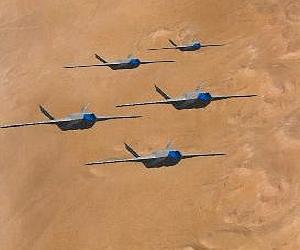
Boeing has reported the successful autonomous communications and operation of dissimilar unmanned aerial vehicles (UAV) in flight tests over the rugged terrain of eastern Oregon.
The July 7-10 mission used two ScanEagles manufactured by Boeing subsidiary Insitu and one Procerus Unicorn from The Johns Hopkins University Applied Physics Laboratory (JHU/APL). The UAVs communicated using a Mobile Ad Hoc Network and swarm technology developed by JHU/APL.
The UAVs worked together to search the test area through self-generating waypoints and terrain mapping, while simultaneously sending information to teams on the ground. A broader demonstration is planned for the end of September. Swarm technology is similar to how insects communicate and perform tasks as an intelligent group.
"The test team proved that these unmanned aircraft can collect and use data while communicating with each other to support a unified mission. This swarm technology may one day be used for search-and-rescue missions or identifying enemy threats ahead of ground patrols."
"We're excited we were able to demonstrate this capability on deployed vehicles such as the Boeing ScanEagles."
The ScanEagle system also recently took part in the successful test of a Boeing-developed narrowband communications relay that was used to link handheld radios in the mountains of California.

No comments:
Post a Comment